|
The Project | Introduction | The Team | Publications | The Data | Contact |
|
|
|
Right:
Diffuse Infrared Background Experiment (DIRBE) observations of the
bulge at 1.25, 2.2, 3.5 and 4.5 microns.
Intensities are represented using color contours spaced logarithmically.
Calibrated data at a fiexed solar elongation of 90 degrees, after
removal of foreground signal from interplanetary dust, correction
for extinction and subtraction of the empirical model for the disk.
(Figure taken from Weiland 1994, ApJ, 415, 81).
|
|
|
|
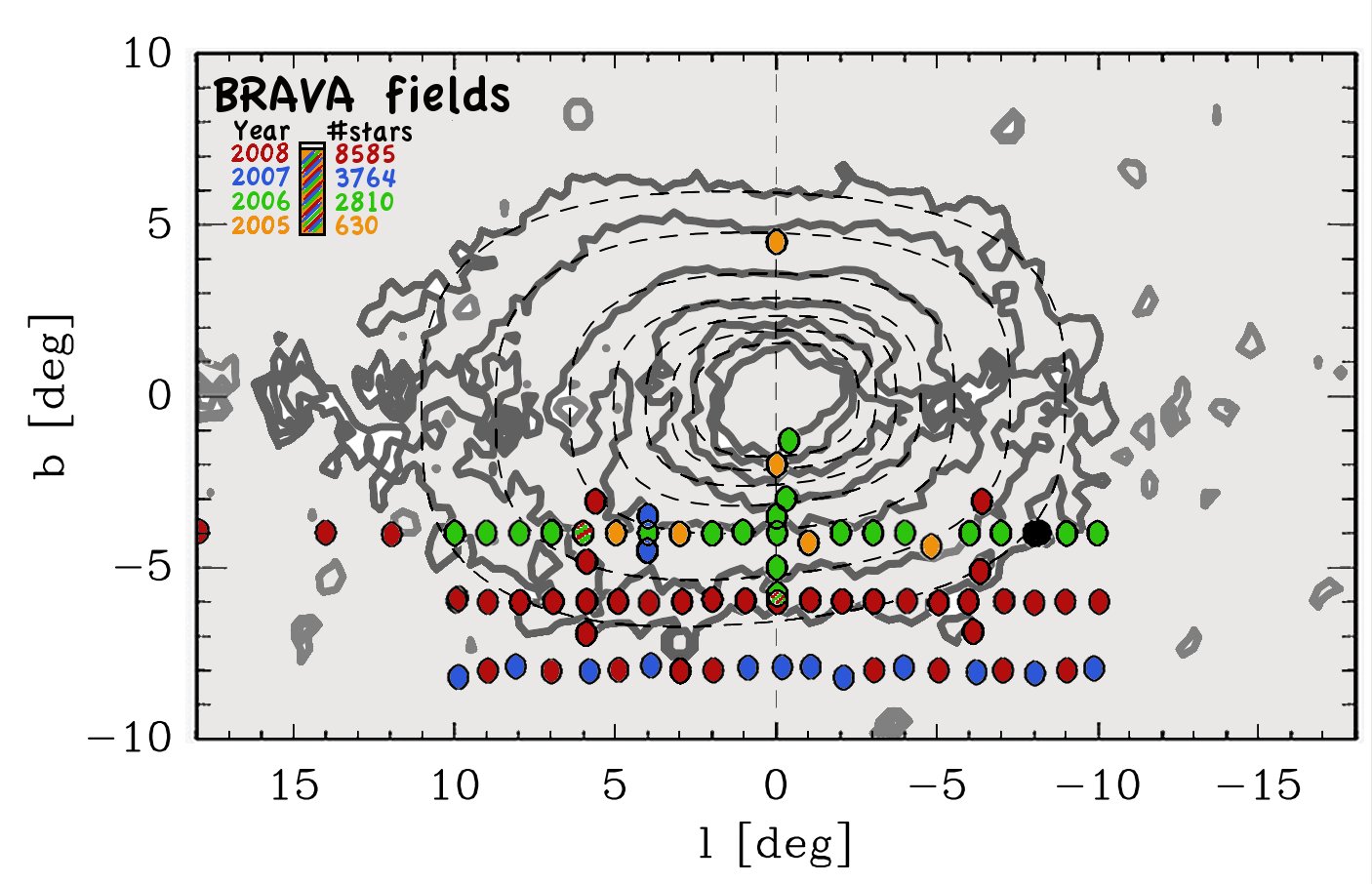
Importance Right: The BRAVA idea.
BRAVA is a survey based on red giants, the stars which comprise
the bulk of the 2.4 micron light of the bulge. M giants offer a
dynamical probe that is populous, is luminous, traces the light, and
is easily utilized for velocity measurements. M giants are also extremely
well studied and have been identified, and their giant branch
characterized, over the whole of the bulge, from 3 degrees to 12 degrees
(420-1675 pc, adopting R_0=8 kpc). Given their significant
contribution to the integrated light, these stars are excellent
dynamical probes. The M giants, being luminous, are also usable as probes
even in regions of high extinction and for exploring the fringes of the
bulge.
BRAVA obtained radial velocities of M giants using the HYDRA
multiobject spectragraph mounted on the BLANCO 4m telescope.
Observation began in 2005 and continued through 2009, yielding
more than 40 individual bulge fields and a hand full of disk fields.
|
|
 |
 |
|
The Bulge Radial Velocity Assay, or BRAVA was conceived as a survey of the line-of-sight velocity distribution of red giants across the bulge, to be compared with self-consistent dynamical models.
|
Last updated on: 09/29/2010